The most expensive mistake is the wrong builder, not the wrong quote
Choosing a builder is one of the biggest decisions you will make about your home, and one of the easiest to get wrong.
On paper, the quotes look similar. Everyone says they do great work. Everyone seems friendly at the first meeting. And unless you have built before, it is genuinely hard to tell who you can trust with what is often your largest single investment.
Here is the reassuring part. The difference between a safe pair of hands and a costly mistake is usually visible in the very first conversation, long before anyone lifts a hammer. You just have to know what to ask.
This guide gives you twelve questions to take to every builder you meet. Each one comes with why it matters and what a good answer sounds like, so you can compare builders properly rather than lining up three numbers and picking the smallest. Print it, take it to every quote, and watch how quickly the right builder stands out.
We are Parris Builds, a family-owned team of Licensed Building Practitioners working across the North Shore and North West Auckland. We wrote this because we would rather you chose the right builder, fully informed, than the cheapest one and regretted it.
Why the lowest quote is rarely the cheapest job
Before the questions, one idea worth sitting with.
When two quotes look far apart, the gap is almost never "the same house for less money." It is a different scope, different materials, a different level of accountability, or a different set of corners quietly cut where you cannot see them. The lowest number on day one has a habit of becoming the highest number by handover, through variations, delays, and remedial work that a proper build would never have needed.
A well-built home protects you three ways the headline price cannot show: it is done right the first time, it is backed by real legal guarantees, and it holds its quality and value for decades. That is the true cost comparison, and it is the one these questions are designed to draw out.
Now, the questions.
Part 1: Licensing and legal protection
This is where a good builder separates from a risky one fastest, because these protections are set by law, not by marketing.
1. Are you a Licensed Building Practitioner, and can I have your LBP number?
Short answer: they should say yes without hesitation and give you a number you can check yourself.
Why it matters: Only Licensed Building Practitioners can legally carry out or supervise the structural and weathertight work that keeps a home sound, including foundations, framing, roofing, and cladding. Hiring an LBP also gives you automatic legal protections that an unlicensed builder simply cannot offer. Here is the part most people never think to do: you can look up any LBP number on the public register at lbp.govt.nz and confirm their status and history in about a minute. A builder who is proud of their licence will happily hand you the number. Hesitation here tells you everything.
A good answer sounds like: "Yes, here is my LBP number, feel free to check it on the register."
2. What guarantees and warranties come with your work?
Short answer: an LBP's work carries a 10-year implied warranty under the Building Act, plus a 12-month defect period.
Why it matters: When you hire an LBP, your build is backed by protections the law requires, not promises a builder invents. Their work carries implied warranties that stay active for 10 years from completion: that the work was done competently, that materials are new and suitable, that the build complies with the Building Code and the consented plans, and that the home is fit to live in. A cheaper, unlicensed quote usually comes with none of this.
A good answer sounds like: "A 10-year guarantee under the Building Act, backed by us as licensed builders."
3. Is there a defect period after the build, and how does it work?
Short answer: yes, a 12-month defect repair period where the builder fixes faults at their own cost.
Why it matters: An automatic 12-month defect repair period starts the day the work finishes. If a fault or minor issue turns up within that year and you notify the builder in writing, they must put it right at their own cost. During that year the burden of proof sits with the builder to show a defect is not their fault, not with you. Most homeowners never ask about this, and it is one of the clearest signs of a builder who stands behind their work.
A good answer sounds like: "If anything is not right in the first 12 months, we come back and fix it at our cost."
4. Will you provide a written disclosure statement?
Short answer: for any residential job over $30,000, an LBP is legally required to give you one.
Why it matters: For residential work of $30,000 or more, an LBP must provide a written disclosure statement and checklist covering their qualifications, the insurance they hold, and the dispute-resolution options available to you. It is a simple, legal test of whether a builder plays by the rules. A builder who works "off the books" or "cash only" will avoid this, because it puts their obligations in writing.
A good answer sounds like: "Yes, you will get that in writing before we start."
5. Are you insured, and what cover do you carry?
Short answer: a clear yes, with the types of cover named.
Why it matters: Proper insurance protects you if something goes wrong on site, from damage to injury. A professional builder carries it as a matter of course and can tell you exactly what they hold.
A good answer sounds like: A confident "yes," with the specific cover named rather than a vague reassurance.
Part 2: Track record and proof
Anyone can say they do good work. These questions ask them to show it.
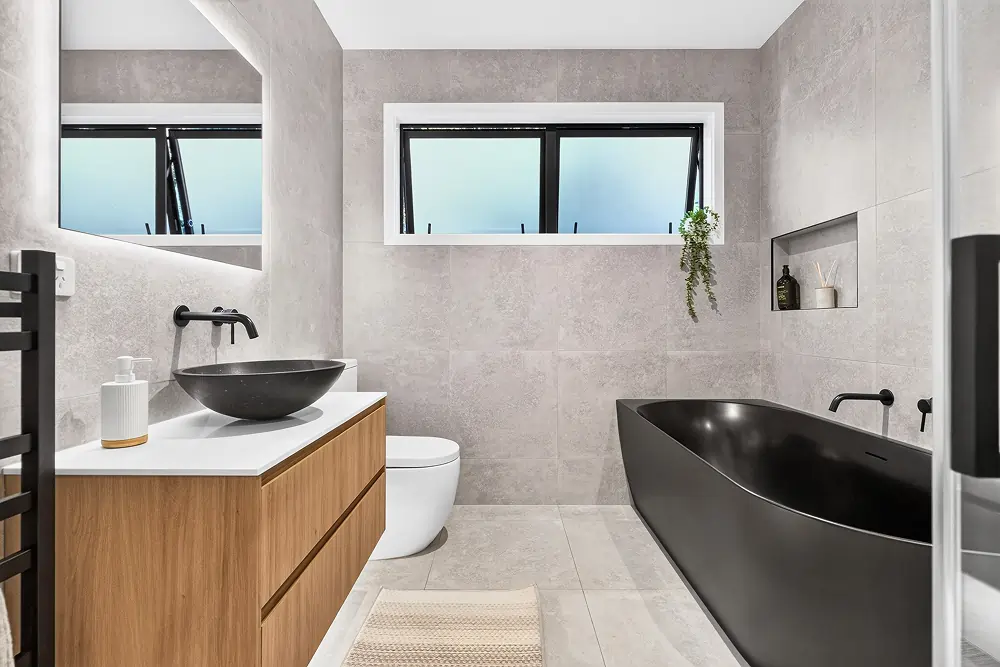
[Image note - proof] A real, finished Parris Builds project shown here, ideally a renovation or new build with visible quality of finish. This sits next to the "show me a project like mine" question and does the same job the question does: proof, not promises. Link the caption through to the Projects page.
6. Can I see a finished project like mine?
Short answer: a builder who does great work will have plenty to show, ideally in your area and your kind of project.
Why it matters: Photos of jobs similar to yours tell you far more than a glossy brochure or a single hero shot. A kitchen renovation, a two-storey extension, and an architectural new build are very different disciplines. You want to see that this builder has done your kind of project, to your standard, and finished it well.
A good answer sounds like: A real portfolio of completed work, with examples close to your project and your suburb. (Ours lives on our Projects page, and we are happy to walk you through the ones most like yours.)
7. Can I see your reviews, and speak to a past client?
Short answer: independent reviews and a reference you can actually phone are the hardest things for a poor builder to fake.
Why it matters: A public review record and a real homeowner you can call are the two proofs that are almost impossible to fabricate. A great builder will have both and will offer them freely. As one of our clients, Jane, a kitchen designer, put it: "I am a kitchen designer, so my quality standards are high. Outstanding quality, great communication, and a stress-free experience from start to finish."
A good answer sounds like: A strong, public review record, and a genuine willingness to connect you with someone they have built for.
Part 3: How you will actually work together
A build is a relationship that lasts months. These questions reveal what that relationship will feel like.
8. Who will I actually deal with, day to day?
Short answer: with a family-owned builder you deal directly with the owners, not a sales rep and a subbed-out crew.
Why it matters: With some larger operators you meet a salesperson, sign, and then get handed to whichever team was cheapest to put on your job. With a family-owned builder, you deal directly with the people whose name is on the work, from the first site visit to handover. That continuity is often the difference between a build that runs smoothly and one that gets lost in translation.
A good answer sounds like: "You will deal directly with us, start to finish."
9. How will you keep me informed during the build?
Short answer: you want honest advice, regular updates, and prompt replies, described specifically rather than promised vaguely.
Why it matters: Poor communication is the number-one complaint homeowners have about builders. A good builder will always keep you informed, so you know where things stand and never feel left in the dark. Ask exactly how and how often they will update you, and notice whether the answer is specific or hand-wavy.
A good answer sounds like: A clear description of the rhythm: who you contact, how often you will hear from them, and how quickly they reply.
10. How do you handle changes and variations once we have started?
Short answer: in writing, agreed before the work happens, never as a surprise on the final invoice.
Why it matters: Almost every build has a few changes along the way, whether you decide to upgrade a finish or the site throws up something unexpected. What matters is how they are handled. A trustworthy builder prices a variation, explains it, and gets your sign-off before doing the work, so a change is never a shock at the end. This one question quietly separates the builders who communicate from the ones who present a bill you did not see coming.
A good answer sounds like: "Any change gets priced and agreed with you in writing before we do it."
11. Do you manage the consent process?
Short answer: yes, a good builder coordinates designers, engineers, and council for you.
Why it matters: Consents, and the job of coordinating designers, engineers, and council, are where many projects stall. A builder who manages this on your behalf takes a large and stressful load off your shoulders and keeps the project moving.
A good answer sounds like: "Yes, we manage consents and coordinate everyone involved for you."
Part 4: Money and timeline
Not the first question to ask, but an important one. Notice these come last, on purpose.
12. How do you handle pricing, what could change it, and what is a realistic timeframe?
Short answer: a detailed written proposal, a clear scope, honest advice on what could move the price, and a realistic programme rather than a hopeful one.
Why it matters: The lowest quote is often the one that grows the most, because the number was optimistic and the scope was thin. You want clarity up front on exactly what is included, straight talk about what could and could not change the price, and a payment schedule that is tied to progress rather than a large deposit demanded before anything happens. On timeline, a builder who quotes a suspiciously fast programme is either cutting corners or setting you up for a delay. A realistic answer is a good sign.
A good answer sounds like: A detailed written proposal, a defined scope, a sensible payment schedule, and an honest programme. No vague numbers, no pressure to sign on the spot.
Red flags to watch for
If you notice several of these, treat it as your cue to keep looking.
- No LBP number, or a vague, uncomfortable answer about licensing.
- No written quote, or a preference for cash.
- A price far below everyone else's. Someone, somewhere, is cutting a corner you will meet later.
- No reviews, no references, and no recent photos of finished work.
- Pressure to sign quickly, or a large deposit demanded before any work begins.
- Unwilling to put the guarantee, the scope, or a variation in writing.
The bottom line
A great builder will welcome every one of these questions, because they have nothing to hide and a great deal to be proud of. The right answers point you to a builder who is licensed, accountable, communicative, and genuinely good at what they do.
That is exactly how we built Parris Builds. We are a family-owned team of Licensed Building Practitioners across the North Shore and North West Auckland, rated 5.0 from more than 45 Google reviews, and every project we complete is backed by a 10-year guarantee. You deal directly with us from the first conversation to handover, you always know where things stand, and we treat your home with the same respect we would expect in our own.
We would honestly rather you asked us all twelve of these questions than none of them.
Frequently asked questions
How much does a builder cost in Auckland? It depends entirely on the scope, the site, and the level of finish, so any builder who quotes a firm figure before understanding your project is guessing. A trustworthy builder will visit, understand what you want to achieve, and give you a detailed written proposal with a clear scope rather than a single number. The more useful question is not "who is cheapest" but "who has priced this properly and stands behind it."
What is a Licensed Building Practitioner, and why does it matter? A Licensed Building Practitioner (LBP) is a builder assessed and licensed to carry out or supervise Restricted Building Work, the structural and weathertight parts of your home. Hiring an LBP gives you automatic legal protections under the Building Act, including a 10-year implied warranty and a 12-month defect period, that an unlicensed builder cannot offer. You can check any builder's licence on the public register at lbp.govt.nz.
Do I need a licensed builder for a renovation, extension, or deck? For anything involving the structure or weathertightness of your home, yes, that work must be carried out or supervised by an LBP. Renovations, extensions, and many decks routinely involve Restricted Building Work, so a licensed builder is not just safer, it is the correct legal path. It also means the same 10-year protections apply to the work.
How long should a build take? It varies widely by project, from a few weeks for a deck or alfresco area to several months for an extension or new build. What matters more than the raw timeframe is honesty: a realistic programme with clear stages, rather than an optimistic promise designed to win the job. Ask for the expected timeline in writing and how the builder will keep you posted if anything shifts.
What questions should I ask a builder before signing a contract? Start with licensing and legal protection: their LBP number, the guarantees and defect period, the written disclosure statement, and their insurance. Then ask for proof: finished projects like yours and a past client you can speak to. Then how you will work together: who you deal with day to day, how they communicate, and how variations are handled in writing. Money and timeline come last. The twelve questions in this guide cover all of it.
Ready to talk about your project?
Tell us what you have in mind, and we will give you honest advice and a clear, detailed quote. No pressure, no obligation, and a real conversation with the people who will actually build it.
[ Get a quote ] · parrisbuilds.co.nz · 027 827 8887
Parris Builds, licensed builders across the North Shore and North West Auckland. Custom new builds, renovations, extensions and alterations, decks and outdoor living.